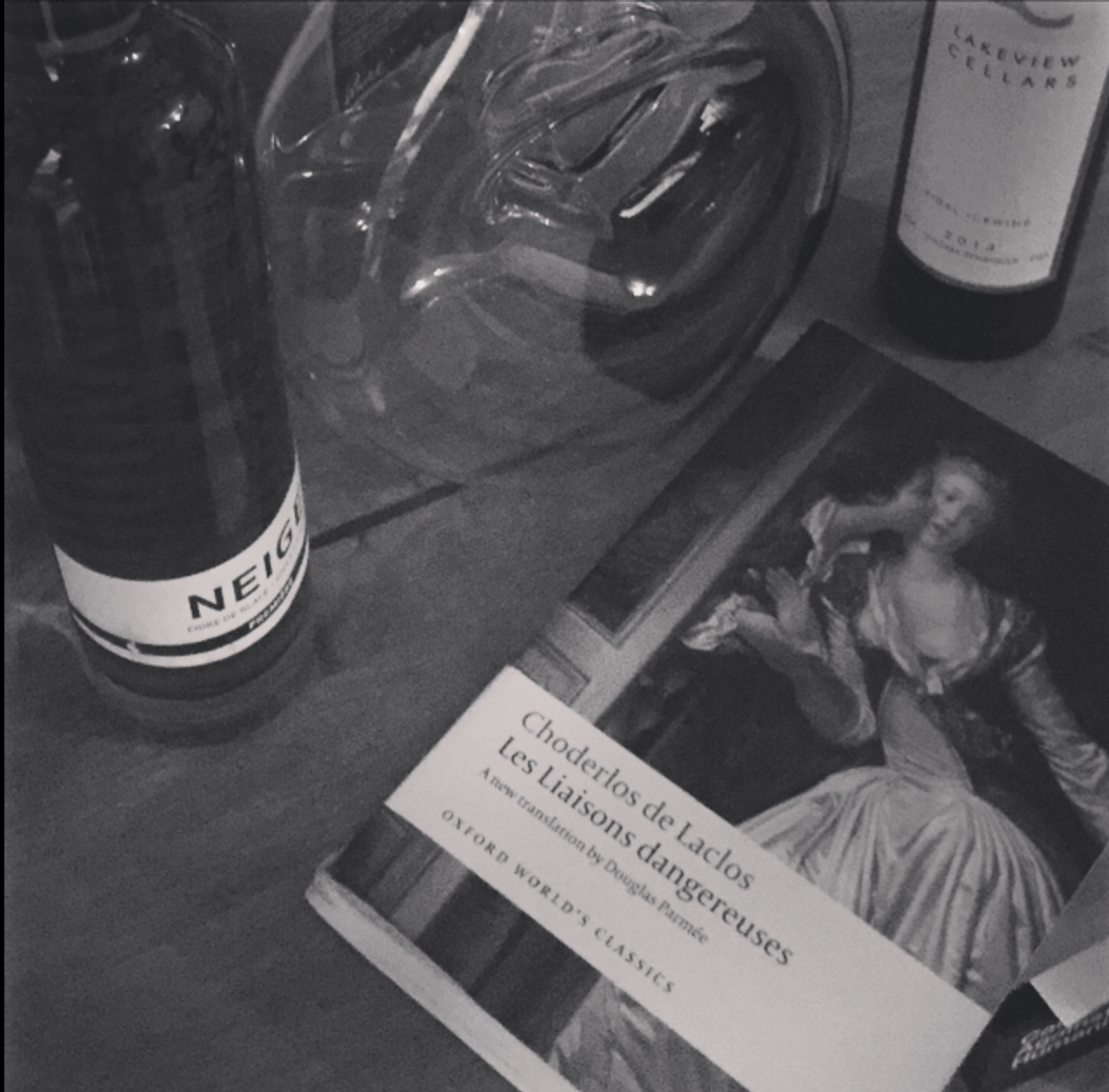
Les Liaisons Dangereuses (Dangerous Liaisons) – Choderlos de Laclos

Les Liaisons Dangereuses choderlos de laclos dangerous Liaisons

“How characteristic of your perverse heart that longs only for what happens to be out of reach.”

Back when I was in college (far more years ago than I feel inclined to admit), I thought I was devastatingly cool. The reason for this was that I always carried around various battered, dog-eared copies of 18th century French novels in my tote bag (which was itself covered with badges depicting band logos). No one ever asked me about the books of course, and I’m not sure I ever even opened them at college – I always read them at home – but regardless, I thought I was terribly exotic.

Not many of these books have stayed in my memory, other than some by Zola (which will feature another day) and Les Liaisons Dangereuses. I remember the utter shock that my naive, seventeen year old self felt the first time I read it. The book was banned in many countries for centuries in some cases, and I could see why! The novel is just SCANDALOUS. There is no other word which fits quite so well.

We follow the extremely rich and extremely bored Marquise de Merteuil and Vicomte de Valmont initially using one another as play things to occupy themselves, before drawing others into their dangerous games. Many people have discussed the moral message Choderlos de Laclos wanted to portray through this novel. I think there is none – he wanted the notoriety of publishing a book which would outrage and disgust as many people as possible.

And I loved it. It feels like the guiltiest of pleasures. It is so easy to be drawn into the Marquise and Vicomte’s games, rooting for one or the other.

What helps is the fact it is so beautifully written. Written in an epistle style, each character has their own, very distinctive voice.

Just as with my review of American Psycho, this novel has a famous and popular film based on it. If you enjoyed the film, please – read the book!

8/10

Les Liaisons dangereuses (Oxford World’s Classics)

https://storage.ko-fi.com/cdn/widget/Widget_2.jskofiwidget2.init(‘Support Me on Ko-fi’, ‘#29abe0’, ‘P5P49PBMG’);kofiwidget2.draw();

American Psycho – Bret Easton Ellis

Bret Easton Ellis American Psycho

This may be too well known a story to review properly, the film starring Christian Bale being so popular, but when I started this blog I promised myself I would review those stories I truly love, and this is one.

If you are one of those people who prefers to just watch the film adaptation, nothing I say is likely to change your mind. BUT: this book is so good I finished it in a day, flipped back to the start and began reading again. It is sublimely mad, the choice of language creating the perfect chaos of Patrick Bateman’s mind.

I am not someone who usually enjoys slasher books – I am a bit of a snob (although I never mind them being amorous…) – but this book is pure entertainment from beginning to end. Is the character realistic? Perhaps not, but when a book grips you as much as this one does, it doesn’t matter much!

Unusually for me, on this occasion, I saw the film before reading the book. I picked the book up in a sale and thought I’d give it a go. You won’t be able to stop reading; you have to consume page after page to find out if he did it, or if it’s all just part of Patrick’s delusions. As the story moves on, and Patrick’s insanity seems to worsen, we are taken on an adrenaline fuelled, sickening rollercoaster of a journey which I enjoyed from start to finish.

10/10

American Psycho

Once – Morris Gleitzman

IMG_0190

“Everyone deserves to have something good in their life. At least once.”

Shockingly, I had not even heard of this book until recently. Teaching World War II to eight year olds, I was researching ‘quality texts’ to enrich their learning. I came across this book during my search and bought it, thinking – naively – that it looked like a nice children’s book.

I settled down on a Sunday to start reading, and did not move or even look up until I had finished. At this point, tears were streaming down my face (and I would not describe myself as a particularly emotional person) and I immediately bought the rest of the books in the series (Then, Now, After, Soon).

The subject matter is not easy. Written from the viewpoint of a young Jewish boy, we witness the horrors of the Holocaust with all of the innocence and pure ignorance of a child. I cried and cried – not only for Felix and his friends, but for every man, woman and child who had to live through (and likely die during) this terrible time. Felix may not have existed, but boys like him certainly did and through this novel, we can see the dangers in not confronting this kind of behaviour.

Everyone knows the Holocaust was terrible, but sometimes it is easy to overlook the human element. Read this book. Absorb this book. Let’s work together to ensure this stops and never happens again, particularly in this divisive world.

10/10

Once (Once/Now/Then/After)

https://storage.ko-fi.com/cdn/widget/Widget_2.jskofiwidget2.init(‘Support Me on Ko-fi’, ‘#29abe0’, ‘P5P49PBMG’);kofiwidget2.draw();

Norwegian Wood – Haruki Murakami

Murakami Norwegian wood

“When it’s raining like this,” said Naoko, “it feels as if we’re the only ones in the world. I wish it would just keep raining so the three of us could stay together.”

Murakami needs no introduction. If you have read none of his work yet, then change this right now. Order a copy of one of (any of) his books and get reading.

I first fell in love with Murakami when a colleague gave me a copy of Sputnik Sweetheart. The novel filled me with confusion and left me with unanswered questions for weeks. I still think about it now.

Norwegian Wood is a very different story. On the surface, it is less complex – it left me with fewer sleepless nights – but still deals with hugely complex themes.

The main characters are trying to fling themselves into adulthood, whilst still reeling from the loss (by suicide) of a friend and lover. Murakami deals with mental illness and depression with great compassion, whilst not shying away from the horror it can bring. We never learn why the friend committed suicide – he is a popular, bright and loved individual; or at least, that is how he is viewed by his friend.

Every time I read Murakami, I am left with more questions than when I started, but this book left me considering, particularly in light of our modern world and the image we portray on social media, how easy it can be to hide struggles from those we are closest too.

This book is by no means an easy read, but I would say it is a necessary one.

10/10

Norwegian Wood